Garage Door Off Track Repair in Kingston, NY
The door is supported, coaxed back onto its rails and hung again on straight track with sound rollers; whatever pushed it out is fixed so the problem doesn't return.
Rollers outside the track, a door tilting or jammed, or a section bowed where it caught all mean a garage door in the Kingston area is off track. Stop using it and don't run the opener, even briefly.
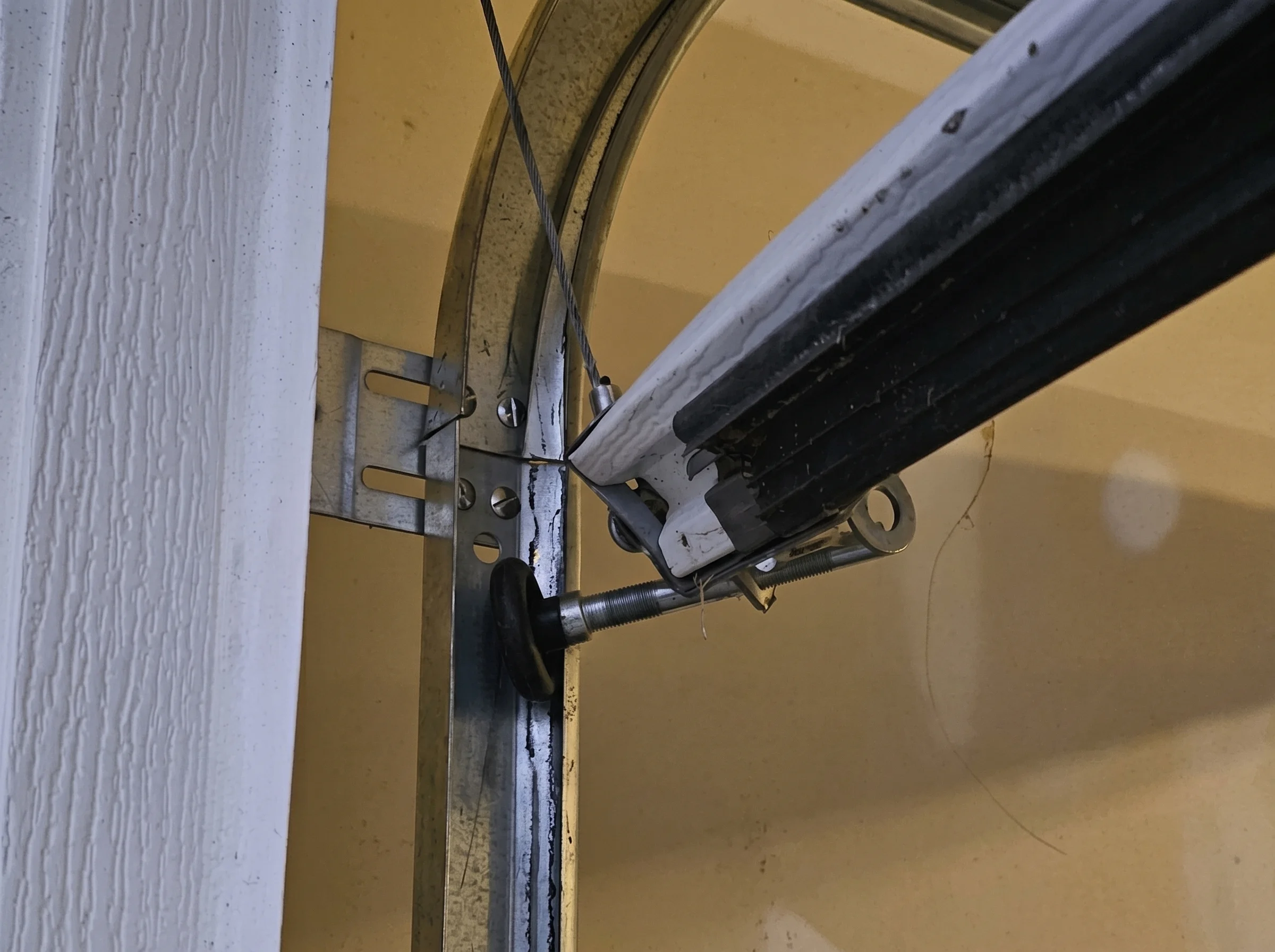
How to tell a door is derailed
One or two rollers sitting outside the track, often low on the door or in the curve where the rail bends upward toward the ceiling.
The door skewed or wedged, often stopped halfway open.
A panel creased or bent where the opener kept driving a jammed door onward.
Rail bent out of shape, dented, or pulling away from the wall.
Popping, scraping or grinding heard just before the door left the track.
Derailed door? Keep the opener off, and let us know which side popped out and what led up to it.
Contact UsWhy a door leaves its rails
A car strike
Backing a vehicle into a shut or half-raised door is the leading cause, and it usually bends the bottom of the rail as well.
A cable that let go
A corner that drops twists the whole door until the rollers pop out; for the slack cable itself, see the cable repair page.
Rollers past their life
Once a roller's bearing seizes, the wheel drags rather than spins and hops out at the first uneven spot.
Slack or bent rail
After years of vibration the brackets holding the rail loosen, and the rail slowly spreads until the rollers escape it.
An obstacle underneath
Something snagged on the way down, worse when the eye sits above the 4 to 6 inches the CPSC advises.
Secure the scene
Keep the opener off
Left running it will bend panels or tear the rail away from the wall.
Leave the emergency release alone if the door sits partly open and out of its track, because it may drop or swing free altogether.
Don't force the rollers back with a hammer while the door bears weight. Spring tension still acts on a derailed door, which can lurch without warning.
Stay out from under the door, and mention it up front if a vehicle is trapped inside.
What a repair looks like
The door gets braced so it can neither drop nor slide during the work, and spring tension is managed as needed.
Damage gets surveyed
Which rollers are damaged, how much rail is out of shape, and whether a panel, cable or spring started it.
Bent rail: straighten or replace
Small bends are worked straight; kinked or torn rail gets replaced.
Rollers that are worn or broken get replaced, and hinges checked as well, as a cracked one can fling a roller out again.
The door goes back in the rails and the brackets are tightened. After test cycles, New York law (GBL 391-k) expects anyone servicing an opener to test its entrapment protection on site.
Describe what went wrong
Even a line or two begins the process, and the damaged part's name isn't something you need to know.
Rollers
Rollers set how smoothly and quietly a door travels, and they wear out long before the door itself does.
Plain steel wheels with no bearings are the simplest design: loud, and abrasive to both themselves and the rail.
Sealed-bearing nylon rollers turn much more quietly and need hardly any lubrication.
Wobble, flat spots, cracks or seized bearings tell you a roller needs replacing.
For a door that is merely noisy, new rollers frequently solve most of the problem, and that work often fits into a maintenance visit.
What affects the cost of a derailment repair
How far the door slipped out
Two rollers loose at one corner, or a door hanging free.
Rail damage
Whether rail is trued or replaced, on one side or both.
Rollers and hinges worn past use.
Creased or cracked panels
A badly bowed panel may have to be replaced, which can mean tracking down a match for an older door.
A cable or spring failure that set off the derailment.
Panels that can't be saved
A heavy blow can leave panels too creased to straighten. Often one panel can be exchanged while the rest of the door stays, so long as the manufacturer still makes a match.
If that isn't the case, or several panels are damaged, garage door installation walks through the replacement options.
Quick answers
Can I seat a roller back in the track on my own?
Only for one roller out at the bottom of a closed door, with straight track and no loose cable. Beyond that, stop; the U.S. Consumer Product Safety Commission says binding or sticking doors need a professional.
What makes my door pop out on the same side every time?
Usually the track is slightly out of line, a bracket is loose, or the cable on that side needs adjusting. Re-hanging without fixing the cause just means it will come out again.
Should the rails get oil?
No. A clean, dry rail is what you want, since oil only attracts grit. Lubricant belongs on the roller bearings, hinges and springs.
More garage door services
Garage Door Spring Repair
Spring replacement for broken torsion or extension springs, sized to the door's weight.
Visit page →Garage Door Installation
Complete new doors in steel, wood, composite or glass, made to fit your opening.
Learn more →Share details
Say where the door stopped (closed, open or partway), which side came off, whether anything hit it, and if a cable seems slack.
The best thing to send is a photo of each side from a few feet back; it saves a lot of guessing.